Beyond the Paint: Unpacking What Every Nissan Brake Caliper Color Truly Means
Article summary
In the intricate tapestry of automotive design and engineering, where every line, curve, and material choice speaks volumes, there exists a subtle yet profoundly significant detail: the color of a vehicle's brake calipers. For enthusiasts and discerning drivers, these painted components are far more than mere aesthetic flourishes; they are a direct, visual shorthand for the performance capabilities lurking beneath the wheel. Nissan, a marque renowned for its blend of accessible innovation and outright performance, masterfully leverages this visual language. From the workhorse sedans to the legendary Godzilla, the hue of a Nissan's brake caliper tells a compelling story about its intended purpose, its engineering pedigree, and the level of dynamic prowess it's designed to deliver. It’s a silent declaration of intent, a badge of honour for those in the know.
At the foundational level, we typically encounter brake calipers finished in understated shades of silver, grey, or black. These are the unsung heroes of daily commutes, found on models like the Altima, Rogue, Kicks, and Pathfinder. While not overtly flashy, these calipers are engineered for reliability, durability, and consistent stopping power under a wide range of everyday driving conditions. They represent Nissan’s commitment to safety and efficiency for the vast majority of its clientele. These single or dual-piston floating calipers, often sourced from reputable suppliers or manufactured in-house to Nissan's exacting standards, provide ample braking force for their respective vehicle weights and performance envelopes, ensuring confidence and control for the average driver without drawing unnecessary attention.
As we ascend the performance ladder, a more vibrant and universally recognized hue emerges: red. In the automotive world, red calipers are synonymous with sportiness, enhanced performance, and a clear step above the ordinary. Nissan employs red calipers on its more spirited models and performance trims, notably within its revered Nismo sub-brand. Think of the 370Z Nismo, the Sentra Nismo, or even earlier iterations of the GT-R V-Spec II. These red calipers often signify a move to larger, more robust braking systems, frequently featuring multi-piston fixed calipers (often 4-piston units) from specialists like Akebono. This upgrade isn't just for show; it translates to improved heat dissipation, greater resistance to brake fade during enthusiastic driving, and a more direct, confidence-inspiring pedal feel. The visual pop of red serves as an immediate indicator that this Nissan is ready for more than just the school run.
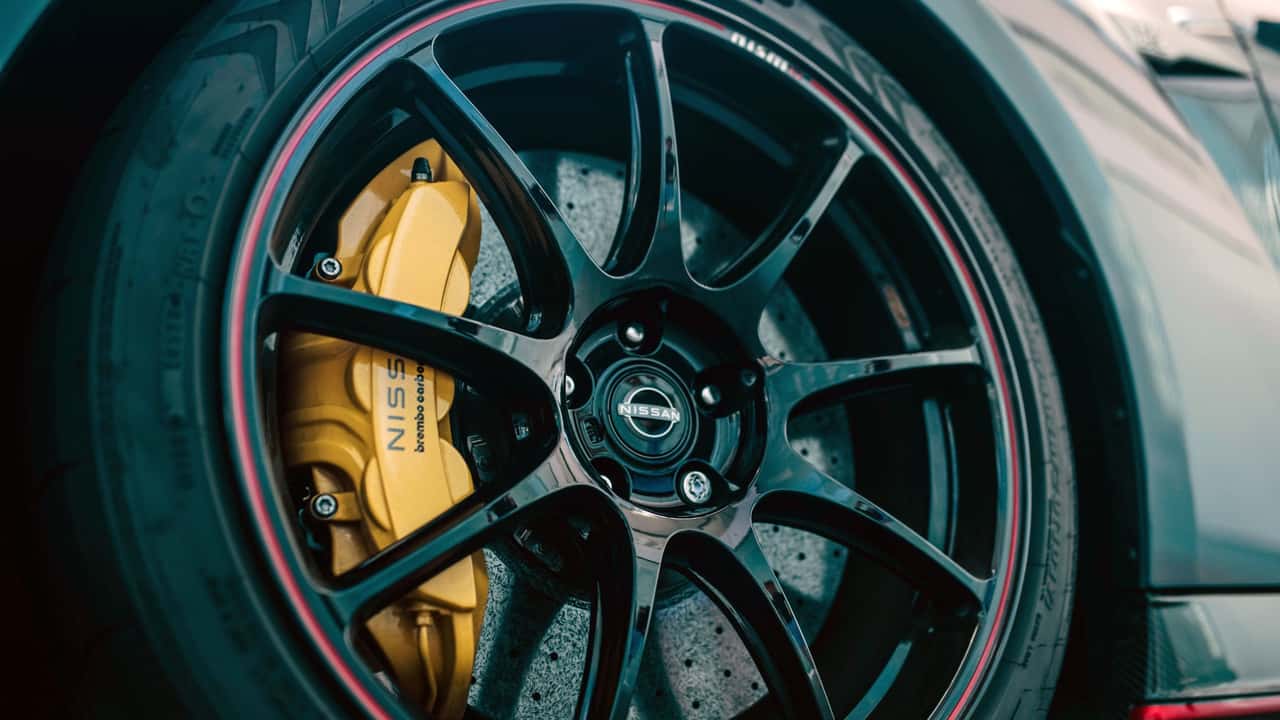
Then, we reach the zenith of Nissan's braking hierarchy, where colors like gold, bronze, or even yellow make a rare but impactful appearance. This is the exclusive territory of models engineered for extreme performance, epitomized by the mighty Nissan GT-R Nismo. The gold-painted Brembo calipers on the GT-R Nismo, for instance, are not merely cosmetic; they encapsulate a truly formidable braking system. These are typically massive 6-piston (front) and 4-piston (rear) monobloc calipers, clamping down on enormous, cross-drilled and ventilated rotors – sometimes even carbon-ceramic in other high-performance applications, though the GT-R Nismo traditionally uses steel. This sophisticated hardware is designed to withstand relentless track abuse, providing phenomenal stopping power, exceptional fade resistance, and precise modulation even at eye-watering speeds. These colors are reserved for the absolute pinnacle, signifying a vehicle capable of challenging physics.
It's crucial to understand that the caliper color is merely the visible tip of an engineering iceberg. The true performance differential lies in the entire braking system package. Moving from standard grey to aggressive red, and then to elite gold, typically involves a cascade of technical upgrades: larger diameter rotors for increased leverage and heat capacity, thicker rotors to resist warping, multi-piston fixed calipers that offer superior clamping force and more even pad wear, higher-performance brake pads with specialized compounds, and often braided stainless steel brake lines for a firmer pedal. These components work in concert to provide shorter stopping distances, improved pedal feel, and significantly enhanced thermal management, allowing for repeated hard braking without degradation in performance. The color, therefore, becomes a convenient and stylish emblem of this underlying technological sophistication.
Ultimately, Nissan's strategic use of brake caliper colors transcends mere aesthetics; it's a clever form of brand communication and a subtle nod to its rich performance heritage. For the casual observer, it might just be a splash of paint, but for the automotive enthusiast, it's an instant read on a vehicle's capabilities and an insight into the engineering philosophy that drives the brand. It allows Nissan to clearly delineate its product hierarchy, adding a layer of aspiration and prestige to its performance models. So, the next time you spot a Nissan, take a moment to glance at its calipers – they just might reveal a deeper story than you ever imagined.
OBD2HQ context
This article helps vehicle owners track changes that may affect maintenance cost, safety technology, service access and resale value. It is not a diagnostic procedure; if you have a warning light or symptom, open the matching OBD2 code, vehicle profile or car problem finder.